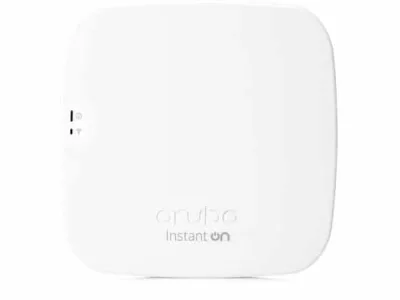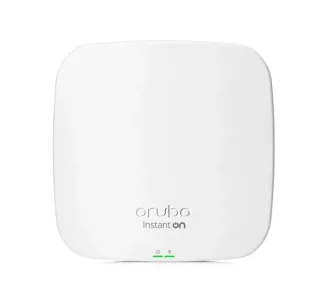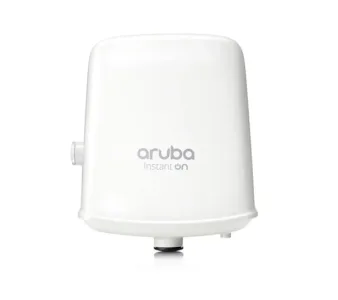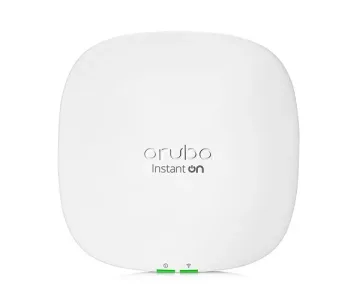


Chi tiết và thông số kỹ thuật
Wireless Aruba 580 Series Wifi tại SMNET có gì nổi bật
Vận hành doanh nghiệp vô cùng phức tạp; do vậy, giảm thiểu nỗ lực từ bất kỳ khía cạnh nào là một điều nên làm, đặc biệt nếu nó liên quan tới công nghệ thông tin. Đó cũng chính là điều Aruba hướng tới khi giới thiệu sản phẩm Aruba 580 Series Outdoor Access Points, gắn cho sản phẩm này sứ mệnh “Ít nỗ lực cho công nghệ thông tin để tập trung xây dựng bộ máy kinh doanh”.
Những tính năng và lợi ích của sản phẩm
Hiệu suất Wi-Fi 6 cao nhất cho môi trường ngoài trời khắc nghiệt nhất
AP ngoài trời duy nhất của chúng tôi có Bluetooth và Zigbee công suất cao, cùng với khả năng kết nối nhiều gigabit dành cho các môi trường đòi hỏi khắt khe bao gồm cả các địa điểm công cộng.
IP66/67 Xếp hạng cho Môi trường Ngoài trời Khắc nghiệt
Mục đích được chế tạo để tồn tại trong môi trường ngoài trời khắc nghiệt nhất và nhiệt độ khắc nghiệt (-40 đến +65˚ C).
Bluetooth 5 và 802.15.4/Zigbee công suất cao
Đơn giản hóa việc triển khai và quản lý các thiết bị IoT cho môi trường sản xuất và IoT công nghiệp.
Wi-Fi 6 được hỗ trợ
Cải thiện hiệu quả và bảo mật với các khả năng của Wi-Fi 6 bao gồm MU-MIMO, OFDMA, WPA3.
Thực thi quyền truy cập dựa trên vai trò tự động
Định cấu hình tập trung và tự động thực thi các chính sách dựa trên vai trò trên các mạng có dây và không dây bằng cách sử dụng Tường lửa thực thi chính sách và phân đoạn động.
Ethernet tốc độ thông minh 5 Gbps
Với dung lượng 5 Gbps, Aruba 580 Series đáp ứng nhu cầu của môi trường mật độ cao và mang lại sự liên tục trong kinh doanh.
Tùy chọn năng lượng mạnh mẽ
Tùy chọn kết nối bằng nguồn AC trực tiếp – không cần bộ chuyển đổi – cùng với PSE+ và PoE.
Tags: Thiết bị mạng – Tường lửa, Thiết bị mạng – tường lửa Aruba, Aruba Wireless
- AP-584
- Four dual-band Nf connectors for external antenna operation
- One 2.4Ghz IoT Nf connector for the Bluetooth/Zigbee radio
- 5dBi omni-directional antenna included
- AP-585
- Built in omni-directional antennas (H and V polarized)
- 5Ghz Antennas 4.5dBi uncorrelated avg (5.8dBi peak)
- 2.4GHz Antennas 3.0dBi uncorrelated avg (4.4dBi peak)
- Bluetooth Antenna 4.8dBi peak
- AP-587
- Built in 90°H x 90°V directional antennas (H and V polarized)
- 5Ghz Antennas 5.2dBi uncorrelated avg (6.6dBi peak)
- 2.4Ghz Antennas 5.7dBi uncorrelated avg (5.8dBi peak)
- Bluetooth Antenna 6.3dBi peak
- AP type: Outdoor Hardened, Wi-Fi 6 dual radio, 5GHz and 2.4GHz 802.11ax 4×4 MIMO
- 5GHz radio: Four spatial stream Single User (SU) MIMO for up to 2.4Gbps wireless data rate with individual 4SS HE80 (or 2SS HE160) 802.11ax client devices, or with four 1SS or two 2SS HE80 802.11ax MU-MIMO capable client devices simultaneously
- 2.4GHz radio: Four spatial stream Single User (SU) MIMO for up to 1,150Mbps wireless data rate with individual 4SS HE40 802.11ax client devices or with two 2SS HE40 802.11ax MU-MIMO capable client devices simultaneously
- Support for up to 1,024 associated client devices per radio (typical recommended limit for active outdoor clients is 100-200 depending on distance), and up to 16 BSSIDs per radio
- Supported frequency bands (country-specific restrictions apply):
- 2.400 to 2.4835 GHz (ISM)
- 5.150 to 5.250 GHz (U-NII-1)
- 5.250 to 5.350 GHz (U-NII-2A)
- 5.470 to 5.725 GHz (U-NII-2C)
- 5.725 to 5.850 GHz (U-NII-3/ISM)
- Available channels: Dependent on configured regulatory domain
- Dynamic frequency selection (DFS) optimizes the use of available RF spectrum
- Supported radio technologies:
- 802.11b: Direct-sequence spread-spectrum (DSSS)
- 802.11a/g/n/ac: Orthogonal frequency-division multiplexing (OFDM)
- 802.11ax: Orthogonal frequency-division multiple access (OFDMA) with up to 37 resource units (for an 80MHz channel)
- Supported modulation types:
- 802.11b: BPSK, QPSK, CCK
- 802.11a/g/n: BPSK, QPSK, 16-QAM, 64-QAM, 256-QAM (proprietary extension)
- 802.11ac: BPSK, QPSK, 16-QAM, 64-QAM, 256-QAM, 1024-QAM (proprietary extension)
- 802.11ax: BPSK, QPSK, 16-QAM, 64-QAM, 256-QAM, 1024-QAM
- 802.11n high-throughput (HT) support: HT20/40
- 802.11ac very high throughput (VHT) support: VHT20/40/80/160
- 802.11ax high efficiency (HE) support: HE20/40/80/160
- Supported data rates (Mbps):
- 802.11b: 1, 2, 5.5, 11
- 802.11a/g: 6, 9, 12, 18, 24, 36, 48, 54
- 802.11n: 6.5 to 600 (MCS0 to MCS31, HT20 to HT40), 800 with 256-QAM
- 802.11ac: 6.5 to 1,733 (MCS0 to MCS9, NSS = 1 to 4, VHT20 to VHT160), 2,166 with 1024-QAM
- 802.11ax (2.4GHz): 3.6 to 1,147 (MCS0 to MCS11, NSS = 1 to 4, HE20 to HE40)
- 802.11ax (5GHz): 3.6 to 2,402 (MCS0 to MCS11, NSS = 1 to 4, HE20 to HE160)
- 802.11n/ac packet aggregation: A-MPDU, A-MSDU
- Transmit power: Configurable in increments of 0.5 dBm
- Maximum (aggregate, conducted total) transmit power (limited by local regulatory requirements):
- 2.4 GHz band: +29 dBm (23dBm per chain)
- 5 GHz band: +28 dBm (22 dBm per chain)
- Note: conducted transmit power levels exclude antenna gain. For total (EIRP) transmit power, add antenna gain.
- Advanced Cellular Coexistence (ACC) minimizes the impact of interference from cellular networks
- Maximum ratio combining (MRC) for improved receiver performance
- Cyclic delay/shift diversity (CDD/CSD) for improved downlink RF performance
- Space-time block coding (STBC) for increased range and improved reception
- Low-density parity check (LDPC) for high-efficiency error correction and increased throughput
- Transmit beam-forming (TxBF) for increased signal reliability and range
- 802.11ax Target Wait Time (TWT) to support low-power client devices
- Advanced IoT Existence (AIC) allows for concurrent operation of the IoT and 2.4Ghz radios without issue
- 802.11mc Fine Timing Measurement (FTM):
- for precision distance ranging